From Mining PLCs to AI-Powered Automation: Building the Future SoftPLC



Meet PLCnext Technology, a networking powerhouse bridging IT and OT with ease. Powered by open Linux-based controllers, it supports industrial protocols like OPC UA, MQTT, PROFINET, and PROFIBUS and various more protocols, giving your machines full communication fluency across legacy and modern systems alike. From edge to cloud, PLCnext Technology keeps your data flowing seamlessly.
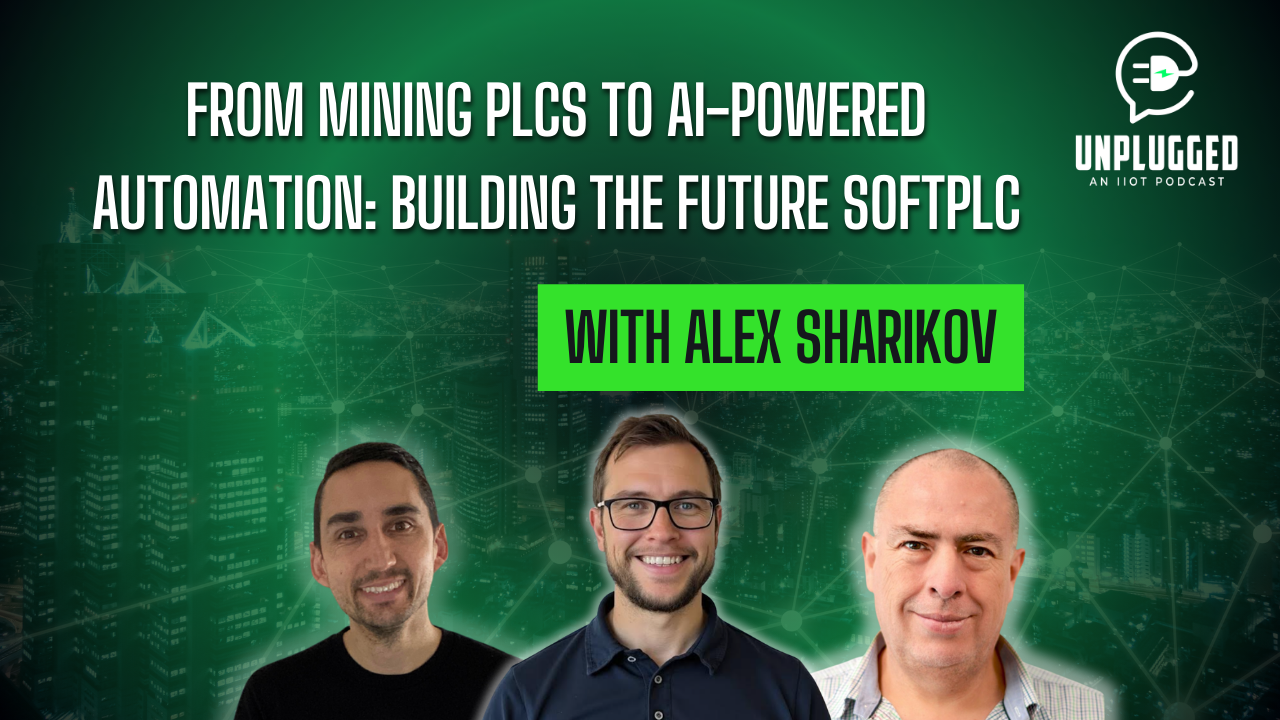
In this episode of Unplugged, hosts Phil Seboa and Ed Fuentes sit down with Alex Sharikov, founder of Jasper-X and creator of JasperNode, an AI-powered SoftPLC that allows manufacturers to program and troubleshoot control systems using plain English. The conversation covers Alex's journey from mining automation in Australia to building a startup that could reshape how small and mid-sized manufacturers interact with their equipment. If you work in industrial controls, run a manufacturing operation, or are simply curious about where AI meets the factory floor, this one is worth your time.
Alex Sharikov's career in automation began about 16 years ago, programming PLCs for underground mining operations in Australia. His work centered on trunk conveyors and drift conveyors, designing, testing, and commissioning control systems built around variable speed drives. "My job was to design, test, and commission," Alex recalls. "Most of the time I was testing and commissioning all of this equipment, including traveling to mine sites and fixing this equipment underground."
The shift to manufacturing changed everything. Mining presented specific but repetitive problems. Manufacturing, by contrast, offered a wider range of complexity on tighter budgets. Alex founded Control-X, his own system integration company, and began working directly with local manufacturers. That hands-on experience would eventually become the foundation for Jasper-X.
One pattern kept emerging across every manufacturer Alex worked with: they lacked dedicated engineering staff. In Australia, roughly 80% of manufacturers have 20 people or fewer. When equipment faults occur, these small teams try to solve the problem themselves. They download PLC software, attempt to connect, and work through troubleshooting step by step until they reach a dead end. Then they call a system integrator.
The cost of this cycle is significant. Production stops, parts get replaced through trial and error, and external electricians rack up hours without always finding the root cause. Alex saw the same scenario repeat across dozens of clients. "The production stopped, they sometimes somehow can produce, and actually, the cost. They have to spend money on these parts, hours for electrician if they use an external electrician."
By the time a system integrator arrives with the right software, the fix often takes 10 or 20 minutes. Alex describes the experience as almost uncomfortable: "It sometimes takes like 10 or 20 minutes and it's done. And I heard from other system integrators and including myself, it just feels unfair after to charge money for that."
When ChatGPT launched, Alex saw an opportunity to solve the problems he had been cataloging for years. What if manufacturers could interrogate their entire control system in plain English? What if they could troubleshoot faults, understand machine behavior, and even make small modifications without waiting for an engineer?
The team initially tried adding AI capabilities to existing PLC platforms, but the diversity of hardware and software made integration impractical. "We have so many different PLCs, like, how do you even tackle this problem?" Alex explains. They concluded that a fresh approach was necessary and began building JasperNode, a SoftPLC designed from the ground up for AI interaction.
JasperNode is not a plugin or an overlay. It is a standalone software package built specifically so AI can create, navigate, and modify control logic reliably. That architectural decision is what separates it from attempts to bolt AI onto traditional PLC environments.
The core innovation behind JasperNode is what Alex calls "atomic and unambiguous logic." In this architecture, every single tag in the system has its own script, and only that script can modify the tag. If a motor on Output 5 keeps cycling on and off unexpectedly, instead of scanning through an entire codebase to trace the trigger, you go directly to the tag's script and follow the chain of dependencies.
"You actually go to that tag which is your output and you see the logic, and this logic will be triggered for another 1 or 2 tags," Alex explains. "You can keep going to another level and go to the next trigger and see what's in that script."
This structure does more than simplify human troubleshooting. It creates the guardrails AI needs to produce consistent and reliable results. Because the logic architecture constrains how tags relate to each other, AI cannot introduce rogue variables or inconsistent naming conventions. "You're creating guardrails how to behave in this system," Alex says. "And because it has a very unambiguous way how we can solve this, it has to do only that way."
The team uses Claude AI for logic generation and reports that hallucination is rare within this constrained environment. After months of testing, the production results surprised them: "We surprised like, oh, it works very well."
Alex is transparent about limitations. JasperNode is designed for soft real-time applications, not motion control or functional safety systems. But it can address roughly 60% of automation use cases, which covers a massive portion of the small manufacturing market.
The conversation turns to one of the most practical challenges in applying AI to industrial automation: getting the context right. Alex points out that prompt engineering has evolved into what the industry now calls context engineering. "You need to hydrate the prompt with the right information," he explains. "You can put everything in and AI gets lost."
When an engineer first sets up JasperNode for a machine, they define the physical reality: what sensors exist, where outputs connect, and how subsystems relate to each other. From that foundation, every subsequent AI interaction builds on established context rather than starting from scratch. The system maintains naming conventions, tag structures, and architectural consistency across prompts.
This approach mirrors what tools like Cursor have done for software engineering. Alex draws the parallel directly: "In software engineering, when people start using Cursor, even people who don't like that, they still use it. As an engineer and a community, as soon as you start using this, you will see the power."
Safety remains central to JasperNode's design. The system operates in two modes: an "unleashed" mode during development where AI can make changes freely, and a "service" mode for production environments where every modification requires human review and approval. "As soon as it's in production, we put in service mode and it always asks and you have to reject or accept," Alex explains.
The longer-term vision is even more ambitious. Alex raises the possibility that manufacturers may not need traditional HMIs at all. If AI understands the full logic of a system, it could proactively notify operators about issues rather than waiting for them to read cryptic alarm codes. "You probably don't even need HMIs in the future," Alex suggests. "Just ask AI because if it knows the logic and everything, it can tell you what's happening."
For now, JasperNode can connect with legacy systems through protocol bridging, working alongside existing PLCs without requiring a full rip-and-replace. Alex's focus for the coming months is on improving context handling, refining communication protocol integration, and finding the industries where JasperNode delivers the highest return for the lowest integration effort.
Perhaps the strongest thread running through the conversation is Alex's view that AI does not replace engineers. It elevates them. "It upskills us," he says. "Instead of trying to figure out some equation or some particular method, I just did it for me, but I have to now think about the bigger picture in architecture."
When manufacturers can handle routine troubleshooting themselves, system integrators get freed up for the work that excites them: designing new systems, expanding capabilities, and solving complex integration challenges. Alex calls it a "win-win-win" scenario: manufacturers keep production running, engineers focus on high-value projects, and the industry moves forward faster.
The community aspect matters too. As one manufacturer gains a competitive edge through AI-powered automation, others will follow. "Their competitor will say, wait a second, how come they're so quick?" Alex predicts. That demand-driven adoption creates a natural ecosystem where engineers, manufacturers, and AI tool builders all push each other forward.
Alex Sharikov is the founder of Jasper-X and creator of JasperNode, an AI-powered SoftPLC that enables natural language programming and troubleshooting for industrial control systems. With 16 years of experience in mining and manufacturing automation across Australia, Alex also runs Control-X, a system integration company serving local manufacturers. Learn more at jasperx.com.au.
PLCnext Technology is the open ecosystem for industrial automation from Phoenix Contact. It brings together open hardware, modular engineering software, a global community, and a digital software marketplace to bridge the worlds of IT and OT.
Digitalization and globalization are placing new demands on industrial automation. The precisely tailored design of the open automation system is just as important as flexible, modular expansion. In addition to standard programming of PLC systems in accordance with IEC 61131-3, parallel programming and the combination of programming languages such as C/C++, C#, and Matlab® Simulink® in real time is also possible with PLCnext Control. Accelerate your application development process with the free basic version of PLCnext Engineer, or use your familiar programming environment.
With simple cloud integration, the option to use open source software, and the ever-expanding expertise of the PLCnext Community, you will benefit from new forms of collaboration. The resulting solution apps, software modules, runtime systems, and function extensions are available in the PLCnext Store and save an enormous amount of time and money when creating applications. This makes PLCnext Technology the ideal ecosystem for your modern automation challenge.