Flowfuse, AI, and the Future of Industrial Automation


FlowFuse is the Industrial Application Platform that connects any machine, moves data across any protocol, models it in any data platform, and operates industrial applications at scale—accelerated by an LLM-powered copilot that uses Model Context Protocol (MCP) to connect AI directly to your live industrial data.
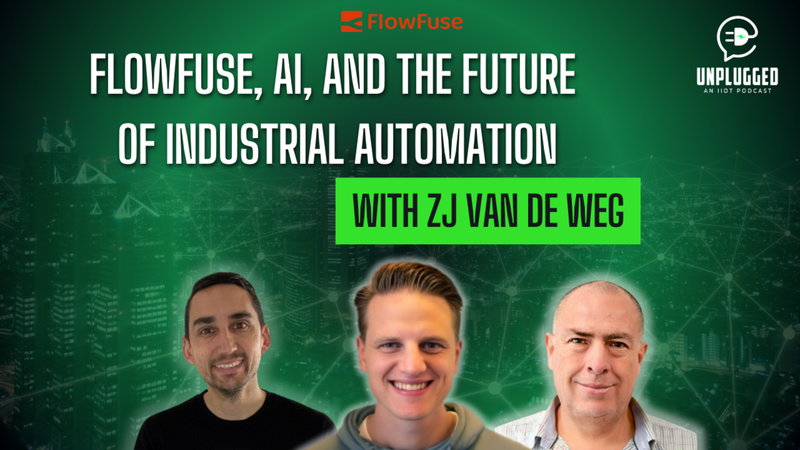
Phil Seboa and Ed Fuentes sit down with ZJ van de Weg, CEO of FlowFuse, to focus on what matters most for modern manufacturing and industrial teams. The conversation explores how low code tools help IT and OT work more closely together, what it really takes to scale Node-RED from small pilots into production environments, and where AI delivers real value in day to day operations. These insights are timely and practical for teams focused on reliability, scalability, and innovation.
Aligning IT and OT teams has always been challenging. ZJ van de Weg explains how the two groups often operate with different backgrounds and expectations, which can create real friction. IT professionals may feel unprepared when working with PLCs and industrial systems, while OT teams can feel overwhelmed by the rapid pace of change in IT technologies.
Low code and visual development tools help close that gap. Phil Seboa points out that electricians and technicians have worked with flow based logic for decades, and visual programming is a natural evolution of that approach in a modern IT context. Tools like Node-RED use graphical, drag and drop interfaces that make logic easier to understand, faster to build, and more accessible to a wider range of users.
Another advantage of Node-RED is its open source ecosystem. ZJ van de Weg explains that teams can quickly connect to PLCs and industrial gateways using existing nodes, allowing them to extract and work with data in minutes rather than weeks. For resource constrained teams, that speed and clarity can make a meaningful difference.
Building a proof of concept is one thing. Running reliable automation across dozens or hundreds of deployments is another challenge entirely. ZJ van de Weg emphasizes that industrial solutions need to work not just today, but for years into the future. Long term reliability, certification, and minimal maintenance are critical when systems are deployed at scale.addresses this by giving organizations the tools they need to manage, update, and monitor Node-RED instances across many locations. Ed Fuentes asks how customers typically deploy these solutions, and the answer reflects reality in most industrial environments. Nearly all customers operate in brownfield settings, using a mix of legacy servers, new hardware, on site systems, and cloud infrastructure.
Flexibility is essential.makes it easier to roll out updates, keep instances aligned, and recover quickly when issues occur. This reduces the operational burden on engineers and gives teams more confidence that systems will continue running as expected.
AI is often discussed in abstract terms, but this episode focuses on where it delivers practical value today. ZJ van de Weg highlights the role of AI, particularly large language models, in data analysis and information access. In read only scenarios, AI can help teams query data, analyze trends, and surface insights without requiring deep technical expertise.
For plant managers and OT teams, this means faster answers and better visibility into performance. At the same time, the conversation is clear about the limits of AI in production environments. ZJ van de Weg advises caution when it comes to allowing AI to make direct changes to live systems, noting that this area will evolve more slowly as teams work through the trade offs.
The takeaway is a balanced approach. AI is already valuable for analysis, monitoring, and decision support, while control changes should remain carefully reviewed by humans to protect uptime and quality.
“The sweet spot so far has been low code just because it has the tools they need. From an OT perspective, if you know how to use Excel, you can now get the data from your machines and publish that to the rest of your architecture or make it useful.” - ZJ van de Weg
Low code tools like Node-RED enable IT and OT teams to collaborate more effectively by making automation visual and accessible.
Scaling from pilot projects to plant wide deployments requires platforms that support updates, flexibility, and mixed environments.
AI is already delivering value through data analysis and alerts, while direct process control still requires a careful, human led approach.
Low code environments are breaking down barriers between IT and OT, helping teams move faster and work together more effectively. When it is time to scale, managed platforms like provide the control and consistency needed across multiple sites. AI is emerging as a valuable partner for data analysis and insights, as long as production changes remain thoughtfully governed.
If you are ready to get practical:
Learn more about FlowFuse:
Learn about FlowFuse at ProveIT Conference:
FlowFuse YouTube Channel:
Listen to our episode with FlowFuse’s Nick O’Leary: