How UNS Transforms IIoT
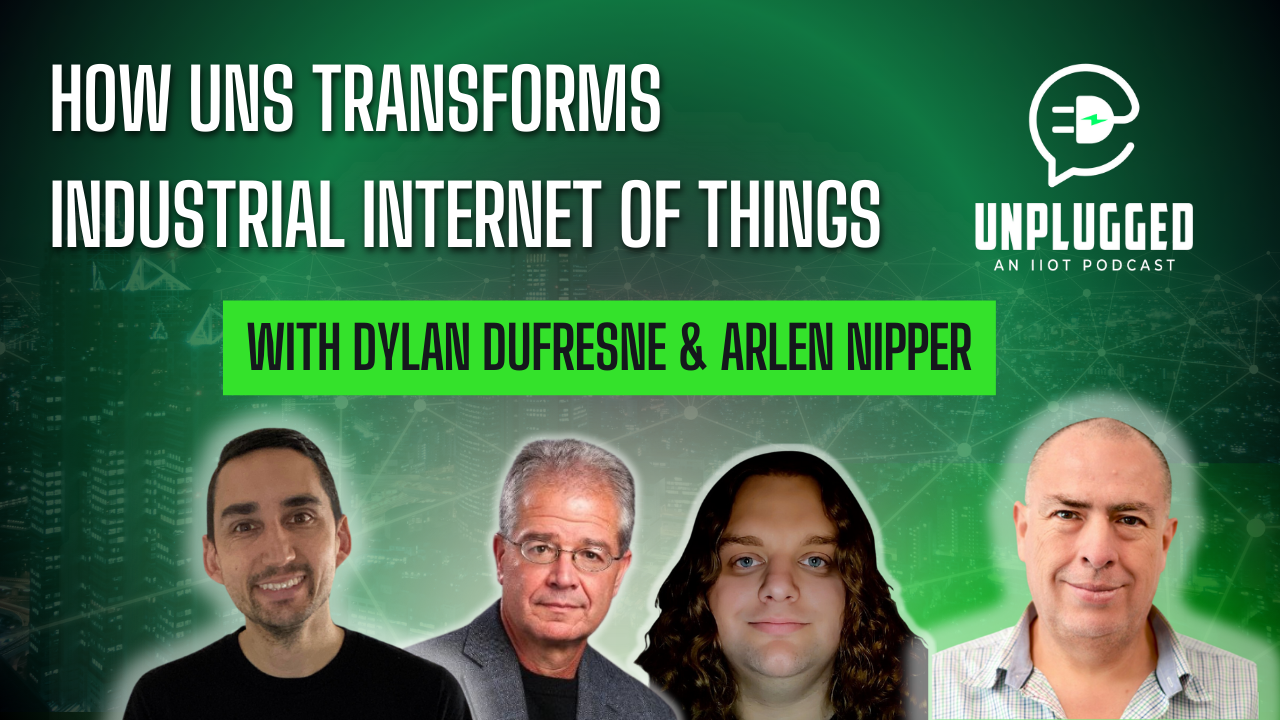


Phil Seboa and Ed Fuentes welcome Dylan Dufresne, a solutions architect specializing in IIoT, and Arlen Nipper, the co-inventor of MQTT, to discuss the intricacies of the Unified Namespace (UNS) within the Industrial Internet of Things (IIoT). This episode delves into understanding UNS, overcoming implementation challenges, and the critical role of integrating technology and people effectively.
Dylan Dufresne provides an insightful explanation of the Unified Namespace, emphasizing that it is not tied to a specific technology or product. Instead, it’s a combination of strategy, roadmap, and a set of rules that allows an organization to create a real-time, transient view of its current business state. "The unified namespace is a combination of a strategy, a roadmap, and a set of rules," says Dylan.
The primary function of UNS is to unify all data within an organization, making it easier to manage and utilize. Phil Seboa articulates the role of technology as an enabler: "Technology is an enabler. It is mostly people and process and getting people to understand some of these high-level concepts." The point here is that while technology plays a crucial role in facilitating the UNS, the ultimate success hinges on the human aspect and well-thought-out processes.
Arlen Nipper and Dylan Dufresne highlight some significant challenges encountered during the implementation of UNS. According to Dylan, both IT and OT teams can sometimes be resistant to adopting new systems due to misconceptions. “There’s often a resistance in adopting new technology due to some misconceptions,” he says. They underline the need to involve all stakeholders from the outset to avoid fragmented efforts that often lead to failure.
Dylan explains the double-edged nature of top-down and bottom-up approaches. The top-down approach may lack essential buy-in from plant operators, while the bottom-up method can falter without executive backing. To avoid this, he recommends a dual approach where both perspectives are addressed simultaneously. "Getting something started is always important. But if you get something started too soon without any direction, then it usually ends up getting stuck somewhere in the middle,” he elaborates.
Dylan emphasizes that while technology forms the backbone of a successful UNS framework, the human element is far more critical. From plant floor operators to executive teams, gaining trust and ensuring everyone’s aligned is vital for success. “The problem and the part where people fall apart, I see more than most, especially on the technical side, is assuming that especially as a systems integrator or as a champion for this project, you know what's best across the board,” he mentions.
The importance of clear communication and targeted education cannot be overstated. Arlen adds, “You need everybody on board at the right time. That doesn't mean everybody has to be on board from day one. And that's where part of the strategy and that roadmap come in as well.” Effectively, it’s about ensuring that technological advancements are both supported by and supportive of the people within the organization.
"The unified namespace is a combination of a strategy, a roadmap, and a set of rules." - Dylan Dufresne
Key TakeawaysThe Unified Namespace serves as an essential framework for real-time business visibility
Overcoming adoption challenges is feasible with a balanced top-down and bottom-up approach.
The human factor—keeping all stakeholders engaged—is crucial for the effective implementation of UNS.
The Unified Namespace provides a robust framework for achieving real-time visibility and efficiency in industrial settings. Adopting a simultaneous top-down and bottom-up approach ensures comprehensive buy-in, while integrating both people and technology leads to a more effective implementation. Listeners are encouraged to engage all relevant stakeholders early on and to focus on educational efforts tailored to their specific teams.
Actionable Suggestions:
Key Takeaways Section:
Dylan Dufresne is a solutions architect with a rich background in industrial automation and the IIoT space. He focuses on integrating various technologies to create streamlined and effective automation systems.
Arlen Nipper, co-inventor of MQTT, has been a key figure in developing efficient, reliable communications protocols critical to the success of IIoT implementations.
By applying the insights shared in this episode, organizations can better navigate the complexities of adopting UNS, paving the way for a seamless integration of their technological and human resources.
Smithtek is committed to providing reliable, Australian-made solutions for remote asset management. Our systems are designed to be intuitive and adaptable, making integration with existing infrastructure straightforward. We prioritize simplicity in user experience, ensuring that our technology is accessible for all levels of technical expertise.
For more information, visit