First Principles: De-Risking Industrial Technology and Championing Sovereign Manufacturing



Meet PLCnext Technology, a networking powerhouse bridging IT and OT with ease. Powered by open Linux-based controllers, it supports industrial protocols like OPC UA, MQTT, PROFINET, and PROFIBUS and various more protocols, giving your machines full communication fluency across legacy and modern systems alike. From edge to cloud, PLCnext Technology keeps your data flowing seamlessly.
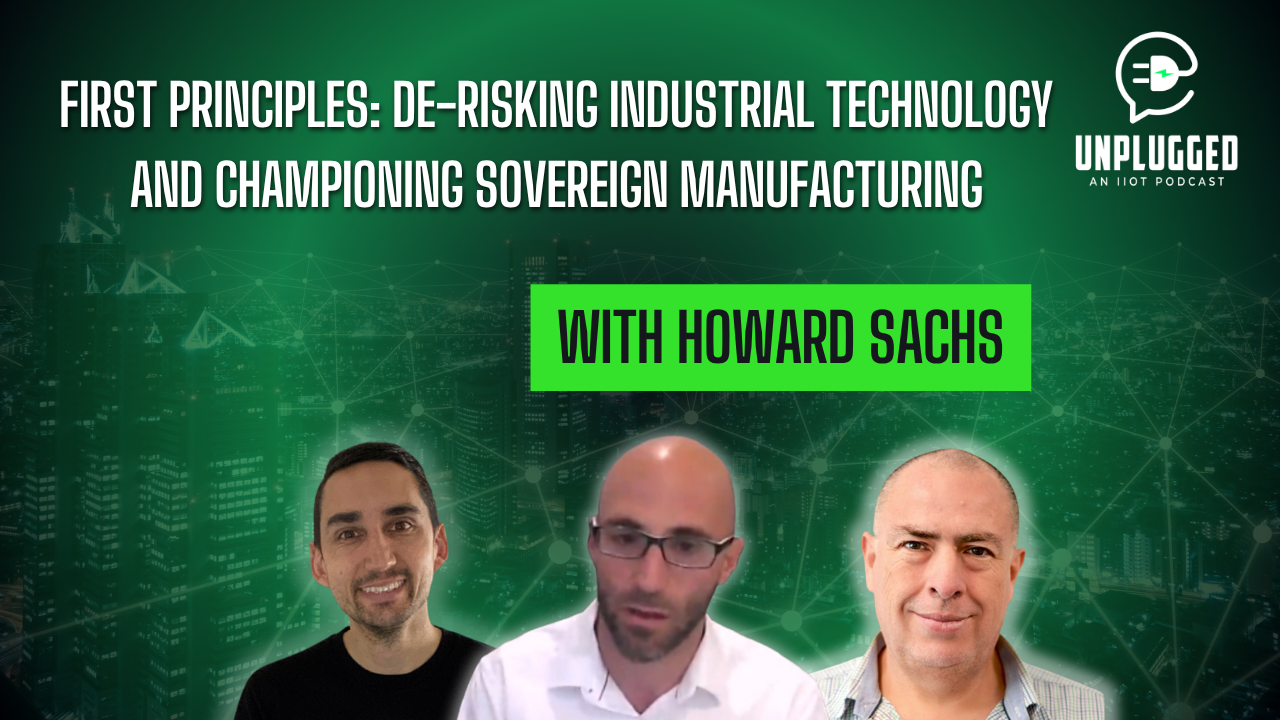
Hosts Phil Seboa and Ed Fuentes sit down with Howard Sachs, a veteran of the industrial automation industry with deep experience across Australia and New Zealand. Howard has spent his career helping organizations improve reliability, adopt new technology, and navigate the commercial realities of industrial decision-making. The conversation covers how customers actually choose technology, why de-risking matters more than product specs, what sovereign manufacturing means for Australia's future, and why mentorship from unexpected sources keeps the industry moving forward.
Howard's path into industrial automation started at university, where a Siemens-sponsored project gave him his first hands-on experience with PLCs, drives, and pneumatics. That early exposure pushed him into the industrial world. He joined Schneider Electric before moving to Siemens, where he spent a significant part of his career growing through progressively senior roles. At Siemens, Howard was exposed to a wide range of industries including chemicals, pharmaceuticals, water, wastewater, defense, manufacturing, and mining.
Beyond the commercial side, Howard has always maintained a strong connection to community. He currently chairs the board of a food rescue organization in Victoria that delivers approximately 50,000 meals per month. That combination of deep industry experience and community leadership shapes how he approaches business today.
Howard now leads Universal Automation Solutions, a Melbourne-based distributor that has secured master distributorships for several major global automation brands. These vendors are comparable in revenue to Rockwell Automation and growing at roughly 24 percent year on year, yet they remain relatively unknown in the Australian market. Howard describes the challenge using an automotive analogy: it is like being BYD entering a market dominated by established names. The product is competitive, but trust has to be earned from the ground up.
When customers evaluate industrial technology, the product itself is only part of the equation. Howard makes the point that once a PLC or drive goes into a cabinet and the door closes, nobody cares about the brand. It becomes a black box performing a function. What customers truly care about is whether the solution will work reliably and what happens if something goes wrong.
This is where de-risking becomes critical. Howard outlines several mechanisms his team uses to take risk off the table for customers. Fixed price contracts remove financial uncertainty. Bank guarantees provide assurance of delivery. Ongoing service contracts and extended warranties demonstrate long-term commitment. And offering customers the option to engage alternative service providers signals confidence in the work.
Howard ties his own accountability directly to the customer outcome. As a company director, he has personal governance obligations under Australian regulations. If he fails to deliver on those obligations, the consequences are severe. That personal stake, he explains, comes across clearly in customer conversations and builds trust that a product brochure alone cannot deliver.
The question of how customers get educated about new technology has also shifted. Howard observes that between AI tools like Copilot, ChatGPT, and Claude, customers are increasingly self-educating. The traditional sales representative with a briefcase has given way to a consultative model, and that consultative model is now merging with AI-assisted knowledge gathering. Howard encourages his customers to use these tools to independently verify product comparisons, which accelerates the trust-building process from both directions.
Howard shares a project from roughly ten years ago with Dulux Paint as one of the most impressive examples of industrial execution he has witnessed. After Dulux's Queensland facility was completely flooded, the company invested in building a new facility focused on security of supply. The result is a manufacturing operation that supplies nearly all the paint in Bunnings and operates close to Industry 4.0 standards.
But Howard attributes the success less to the technology and more to the leadership behind the project. The project director pulled together teams from multiple companies and created a sense of shared purpose that transcended individual or corporate interests. Howard compares it to a Champions League football coach selecting not necessarily the best individual players, but the best combination of people who can work together.
The lesson is clear: once the cabinet doors close and you cannot see what automation is inside, the technology itself is not the differentiator. What matters is how people collaborate to get to that point. True leadership, Howard argues, means pulling everyone in the same direction toward something bigger than any one company or individual.
The conversation turns to sovereign manufacturing and the threats facing Australia's industrial base. Howard identifies capitalism itself as one of the biggest risks. Primary producers, for example, face squeezed profit margins while sitting on land parcels worth significant sums. The financial incentive to sell the land and walk away from farming is real, and Howard does not blame individual farmers for considering it.
The same dynamic plays out in manufacturing. When the major automotive manufacturers pulled out of Australia, the entire supporting supply chain of component manufacturers collapsed with them. Howard sees this pattern as the fundamental threat.
But he also sees a silver lining. COVID-19 exposed the fragility of Australia's supply chains. Ongoing geopolitical tensions have driven fuel prices higher and revealed gaps in strategic reserves. These disruptions are forcing a rethink about how Australia secures its food supply, water treatment, medicine production, and other essentials.
Howard was personally involved in one such effort during COVID-19. While working on the pharmaceutical side of the Siemens business, he watched BioNTech develop the first COVID vaccine using digital twin technology for lipid nanoparticle modeling. Recognizing the opportunity, he contacted his CEO and proposed that Siemens could help Australia develop sovereign vaccine manufacturing capability. That initiative led to consultations with federal and state government ministers and chief scientists, contributing to the push for in-country vaccine production.
The path forward, Howard argues, requires Australians to accept a slight premium for domestically manufactured goods while ensuring that premium remains reasonable. Technology adoption is the key to closing the cost gap. First principles matter here too: before talking about AI and advanced digitalization, manufacturers need to get the basics right. Can the farmer, the OEM, and the producer compete with global alternatives while operating efficiently enough to sustain their business?
Ed asks whether any particular industry is leading the way in innovation. Howard pushes back on the premise. It is not entire industries that are excelling, but rather specific pockets of companies within multiple industries. He points to major consulting firms like Accenture that are pushing the boundaries of AI adoption. In the water industry, traditionally one of the most conservative sectors, individual utilities are finding ways to adopt digitalization and new efficiency technologies.
These innovators are rebels of a sort. Howard observes that in Australia, there is a strong cultural tendency to be "the first to be second," meaning someone else should go first and take the risk. The companies that break from this pattern do so because their leaders are willing to accept that one out of ten decisions might be wrong, while trusting that the other nine will more than compensate. That willingness to tolerate calculated failure is what separates the pockets of innovation from the rest.
Howard frames the broader opportunity in terms of custodianship. Whatever people are building now, whether factories, capabilities, or communities, they are custodians for whoever comes next. The question is whether they will leave things in a better state than they found them.
When asked about his own learning, Howard is candid. He would love to say he has thrown himself into AI or cryptocurrency, but the truth is more grounded. His deepest learning comes from mentorship, and his definition of mentorship is broad. His mentors include podcasts, books, people older than him, and people much younger.
Howard shares a story about asking his ten-year-old son who his oldest friend is, then realizing that his own friends span from people in their 80s to children in single digits. He credits the young volunteers at the food rescue organization he chairs with teaching him an enormous amount about generational thinking. The richness of interacting with people across different ages and backgrounds is, for Howard, the most powerful form of continuous learning.
"We regret the things we don't do more than the things that we do do. So just give it a crack. We can only be better for it." -- Howard Sachs
De-risking is the real sales conversation in industrial technology. Product specifications matter, but customers are ultimately asking who will stand behind the solution when something goes wrong. Fixed price contracts, bank guarantees, extended warranties, and personal accountability build the trust that product features alone cannot.
Sovereign manufacturing is not optional for Australia's future. COVID-19, supply chain disruptions, and geopolitical pressures have made it clear that food, water, medicine, and essential goods must be producible domestically. Technology adoption is the bridge between aspiration and affordability.
Leadership and collaboration outperform technology alone. The most impressive industrial projects succeed because someone creates a shared sense of purpose that transcends individual companies. Selecting the right team of people who can work together matters more than selecting the best individual players.
Howard's advice to the wider community comes in three parts. First, take a chance. The regret from inaction outweighs the cost of a mistake. Second, stay curious. Learning does not require a degree; it requires genuine interest and consistent effort. Third, remember that true fulfillment comes from what you build and give, not from what you accumulate.
Howard Sachs is a director at Universal Automation Solutions, a Melbourne-based distributor of industrial automation and robotics technology serving manufacturers, system integrators, and OEMs across Australia and New Zealand. With a background in electrical engineering and a career spanning Schneider Electric and Siemens across multiple industries, Howard brings deep commercial and technical expertise to the industrial sector. He also chairs the board of a food rescue organization in Victoria, reflecting his commitment to community impact alongside industry advancement.
PLCnext Technology is the open ecosystem for industrial automation from Phoenix Contact. It brings together open hardware, modular engineering software, a global community, and a digital software marketplace to bridge the worlds of IT and OT.
Digitalization and globalization are placing new demands on industrial automation. The precisely tailored design of the open automation system is just as important as flexible, modular expansion. In addition to standard programming of PLC systems in accordance with IEC 61131-3, parallel programming and the combination of programming languages such as C/C++, C#, and Matlab® Simulink® in real time is also possible with PLCnext Control. Accelerate your application development process with the free basic version of PLCnext Engineer, or use your familiar programming environment.
With simple cloud integration, the option to use open source software, and the ever-expanding expertise of the PLCnext Community, you will benefit from new forms of collaboration. The resulting solution apps, software modules, runtime systems, and function extensions are available in the PLCnext Store and save an enormous amount of time and money when creating applications. This makes PLCnext Technology the ideal ecosystem for your modern automation challenge.